
Wireless CCTV vs Wired CCTV
Compare wireless and wired CCTV cameras based on installation, connectivity, reliability, cost, storage and performance. Find the right security system for your home, shop or business in India.
By virnobyte team · · 19 min read

Wireless CCTV vs Wired CCTV: Which Is Better for Your Home or Business in India? (2026)
When planning a CCTV installation, one of the first decisions is whether to choose a wired or wireless camera system. Both options offer remote viewing, motion detection and security monitoring, but they differ in installation, connectivity, power requirements, recording methods and long-term maintenance.
Wired CCTV systems connect cameras to a recorder through physical cables. Wireless CCTV cameras generally transmit video over Wi-Fi or another wireless connection. However, many wireless cameras still require a power adapter, so wireless does not always mean completely cable-free.
For a permanent installation in a shop, office, warehouse or large home, wired IP cameras with Power over Ethernet (PoE) are often a practical choice. Wireless cameras may be more convenient for small installations, rented properties and locations where running cables is difficult.
In this guide, we compare wireless CCTV vs wired CCTV based on installation, reliability, connectivity, video quality, storage, power consumption, cost and performance. We also explain which system is suitable for different types of properties in India.
1. What Is Wired CCTV?
Wired CCTV is a surveillance system in which cameras use physical cables to transmit video to a recorder or network device.
There are two common wired CCTV arrangements:
A. Analog CCTV with DVR
Analog HD cameras connect to a Digital Video Recorder (DVR), usually through compatible coaxial video cables. The cameras may use separate power cables or combined video-and-power cabling.
The DVR records footage on an internal hard disk and can provide remote access when connected to the internet.
B. IP CCTV with NVR and PoE
IP cameras connect to a Network Video Recorder (NVR) or network switch through Ethernet cables.
PoE stands for Power over Ethernet. A compatible PoE switch or NVR can send both power and network data through one Ethernet cable, reducing the need for a separate power cable at each camera.
This is a particularly useful arrangement for offices, shops, showrooms and commercial buildings with multiple cameras.

Advantages of wired CCTV
- Stable physical network connection.
- Does not depend on Wi-Fi signal strength.
- Suitable for multiple cameras and larger installations.
- PoE can simplify camera power and network cabling.
- Works with local DVR or NVR recording without an active internet connection, provided the cameras, recorder and power supply remain operational.
- Suitable for permanent security installations.
Disadvantages of wired CCTV
- Requires physical cable installation.
- Drilling, conduit and cable routing may be necessary.
- Initial installation may cost more because of cabling and labour.
- Moving cameras can require additional cable work.
- Damaged cables can interrupt camera connectivity.
2. What Is Wireless CCTV?
Wireless CCTV cameras transmit their video signals through Wi-Fi or another wireless connection instead of using a dedicated video cable between the camera and the recorder or network.
Many wireless cameras connect directly to a Wi-Fi router and can be managed through a mobile application. Some use microSD cards for local recording, while others support NVR recording or cloud storage.
It is important to understand that wireless does not always mean power-free. Many Wi-Fi cameras still need to be connected to a power adapter. Only battery-powered or solar-assisted models can operate without a permanent power cable at the camera location.
Types of wireless CCTV cameras
- Plug-in Wi-Fi cameras: Connect to Wi-Fi for video but require a nearby electrical outlet.
- Battery-powered cameras: Use rechargeable batteries and may record mainly when motion is detected.
- Solar-assisted cameras: Use a compatible solar panel to help recharge a battery.
- Wireless camera-to-NVR systems: Cameras transmit video wirelessly to a compatible recording unit, but may still need power at each camera.
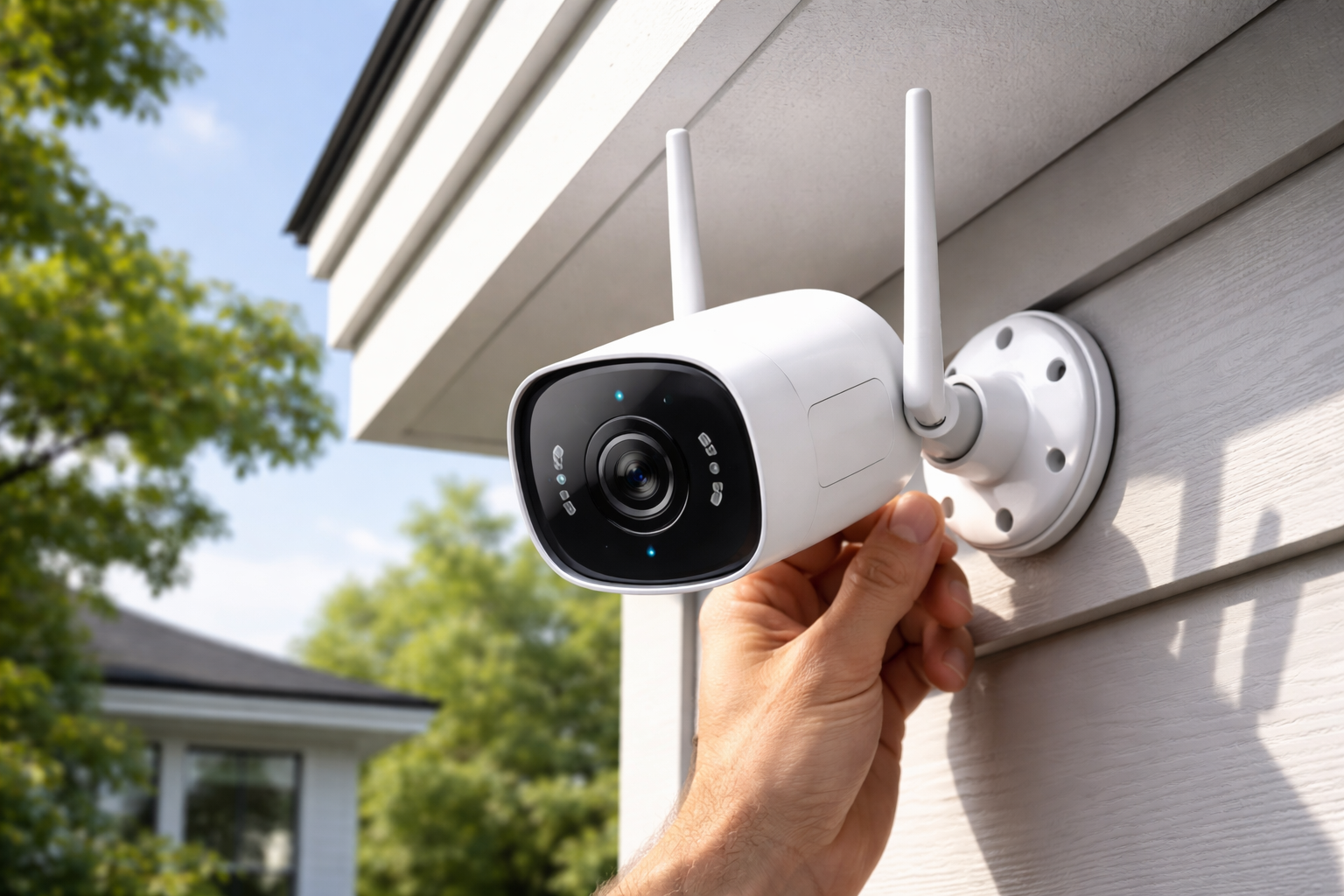
Advantages of wireless CCTV
- Less data cabling compared with a wired installation.
- Usually quicker to install in suitable locations.
- Useful for rented premises or existing buildings.
- Camera positions can be easier to change.
- Many models offer mobile app access and motion alerts.
- Battery-powered models can work in selected locations without a permanent camera power cable.
Disadvantages of wireless CCTV
- Depends on reliable wireless signal coverage.
- Walls, floors and other obstacles can weaken Wi-Fi signals.
- Network congestion may affect video streaming.
- Battery-powered cameras require charging or battery replacement.
- Plug-in Wi-Fi cameras still need power at the installation point.
- Cloud recording may involve subscription charges.
- Setup and maintenance depend on the router and wireless network configuration.
3. Wireless CCTV vs Wired CCTV: Complete Comparison
The following table compares the main differences between wired and wireless CCTV systems.
| Feature | Wired CCTV | Wireless CCTV |
|---|---|---|
| Video connection | Physical cable | Wi-Fi or other wireless link |
| Installation | Requires cable routing | Usually less data cabling |
| Power supply | PoE or separate power, depending on system | Power adapter or battery, depending on model |
| Connectivity | Generally predictable when cabling is installed correctly | Depends on wireless coverage and network conditions |
| Video performance | Stable network connection for compatible systems | Depends on Wi-Fi signal and available bandwidth |
| Installation cost | May be higher due to cabling and labour | Can be lower for simple installations |
| Scalability | Good for planned multi-camera installations | Limited by wireless network capacity and product design |
| Storage | Commonly NVR/DVR hard disk | MicroSD, cloud or compatible NVR, depending on model |
| Remote viewing | Available through compatible recorder or app | Commonly available through compatible app |
| Battery maintenance | Not normally required for PoE or mains-powered cameras | Required for battery-powered models |
| Camera relocation | May require cable changes | Usually easier if power and Wi-Fi are available |
| Suitable applications | Offices, shops, factories and permanent installations | Homes, small shops and selected flexible installations |
4. Installation: Which CCTV System Is Easier to Install?
Installation is one of the main differences between wired and wireless CCTV.
Wired CCTV installation
A wired system requires the installer to route cables between each camera and the recorder, switch or power source.
For a PoE IP camera system, one Ethernet cable can carry both power and network data. For analog systems, coaxial video cabling and a suitable power arrangement are needed.
Typical installation activities include:
- Planning camera locations.
- Measuring and routing cables.
- Drilling and installing conduits where required.
- Mounting the cameras securely.
- Connecting cameras to the DVR or NVR.
- Configuring recording and remote access.
- Testing each camera's live view and playback.
Wireless CCTV installation
Wireless installation may be simpler because video is transmitted over Wi-Fi rather than a dedicated data cable.
Typical setup activities include:
- Checking Wi-Fi coverage at the camera location.
- Providing a suitable power source or charging the battery.
- Mounting the camera.
- Connecting it to the Wi-Fi network.
- Adding the device to the mobile application.
- Configuring storage and motion detection.
- Testing remote viewing and notifications.
5. Connectivity and Reliability: Which Is More Stable?
Connectivity plays an important role in the performance of a CCTV system.
Wired CCTV connectivity
Wired cameras use a physical cable to connect to the recorder or network. This avoids dependence on the Wi-Fi signal for the camera-to-recorder video connection.
When correctly installed, a wired Ethernet or coaxial connection provides a predictable communication path. It is suitable for locations where uninterrupted recording is important.
Wireless CCTV connectivity
Wireless cameras use radio signals to send video to a router, receiver or compatible NVR. Their performance depends on signal strength, interference, router capacity and distance.
Common reasons for wireless connection problems include:
- Weak Wi-Fi coverage.
- Thick concrete or brick walls.
- Distance between the camera and router.
- Interference from other wireless devices.
- Too many devices using the same network.
- Router or access-point problems.
For larger properties, a properly designed Wi-Fi access-point or mesh installation may improve coverage. However, it should be planned and tested rather than assuming that a range extender will solve every connection problem.
Axis explains network video system design and the advantages of Ethernet and PoE in its network video systems guide.
6. Video Quality: Wired CCTV vs Wireless CCTV
Wired and wireless technologies do not automatically determine camera resolution or image quality.
Both types can support Full HD, 4MP, 5MP, 4K and other resolutions, depending on the product.
Actual video quality depends on:
- Camera sensor and lens quality.
- Video resolution.
- Bitrate and compression format.
- Frame rate.
- Lighting and night-vision performance.
- Network bandwidth and connection stability.
A wireless camera with a strong connection can deliver good-quality video. However, if the Wi-Fi signal is weak or the network is congested, video may buffer, disconnect or switch to a lower-quality stream if supported.
Wired IP cameras generally provide a more predictable network connection for high-resolution continuous recording, provided the network and recorder have sufficient capacity.
7. Power Supply: Does Wireless CCTV Need Electricity?
This is one of the most common misunderstandings when selecting wireless cameras.
Most Wi-Fi security cameras still require a power adapter. The video connection is wireless, but the camera itself still needs electricity.
Battery-powered models are different because they do not need a permanent power cable at the camera. Their recording and standby behaviour depends on battery capacity, event activity and manufacturer settings.
| Camera Type | Power Requirement | Important Consideration |
|---|---|---|
| Wired PoE camera | Power supplied through Ethernet | Requires a compatible PoE switch or NVR |
| Analog wired camera | Usually separate compatible power supply | Requires suitable power cabling |
| Plug-in Wi-Fi camera | Power adapter | Needs a nearby electrical supply |
| Battery Wi-Fi camera | Rechargeable battery | Requires battery charging or replacement |
| Solar-assisted camera | Battery with compatible solar panel | Depends on sunlight and battery design |
8. Storage: How Do Wired and Wireless CCTV Systems Save Footage?
Storage requirements depend on the camera's recording quality, bitrate, recording duration and retention period. The difference is mainly in where and how the system stores video.
Wired CCTV storage
Traditional DVR and NVR systems commonly store footage on an internal surveillance hard disk. This is useful for continuous recording across several cameras.
Wireless CCTV storage
Depending on the product, wireless cameras may use:
- MicroSD cards installed inside the camera.
- Cloud storage, sometimes requiring a subscription.
- A compatible network video recorder.
- Network or local storage options supported by the device.
For example, TP-Link's India product specifications show that selected Tapo cameras support microSD storage and cloud storage, while some models also support Ethernet connectivity. Check the exact model before assuming that all wireless cameras have the same storage options.
Read the official specifications of TP-Link Tapo C320WS and TP-Link Tapo C222.
Read our related guide: How Much Storage Is Required for CCTV Cameras? (replace this homepage link with the actual published article URL).
9. Installation Cost and Long-Term Cost Comparison
The total cost of a CCTV system includes more than the price of the cameras.
A wired installation may involve additional cable, conduit, switches, recorder and labour costs. A wireless setup may reduce cabling expenses but can still require adapters, batteries, Wi-Fi equipment or cloud-storage subscriptions.
| Cost Factor | Wired CCTV | Wireless CCTV |
|---|---|---|
| Camera price | Depends on camera category and specifications | Depends on product and battery features |
| Installation labour | May be higher due to cable routing | Often lower for simple installations |
| Cabling | Ethernet or coaxial cabling required | Less video/data cabling required |
| Power arrangement | PoE or separate power | Adapter, battery or solar-assisted power |
| Recorder and HDD | Commonly included in multi-camera systems | May be optional depending on model |
| Cloud subscription | Optional in supported systems | May be required for selected cloud features |
| Long-term maintenance | Cables, HDD, recorder and power equipment | Wi-Fi, battery, app, storage and power equipment |
There is no fixed rule that wireless CCTV is always cheaper. A small Wi-Fi installation may be economical, while a large wireless system may need additional networking equipment and multiple power arrangements. A wired system may cost more initially but can be more practical for a permanent multi-camera installation.
10. Which CCTV System Is Better During Internet or Power Failure?
It is important to distinguish between losing internet connectivity and losing electrical power.
When the internet stops working
A wired DVR/NVR system can generally continue recording locally if the cameras and recorder are powered and the local connection remains functional. Remote viewing from outside the property may stop until internet service returns.
A wireless camera may also continue recording locally to a microSD card if its model supports local recording without internet and the camera remains powered. Cloud-only recording may be interrupted when the internet connection is lost.
When the power supply fails
Both wired and wireless systems require power. A PoE camera, recorder, router and PoE switch may stop operating during a power failure unless supported by a UPS or backup power system.
A battery-powered camera may continue operating during a power cut, depending on its battery condition and system design. However, the router or recorder may also need backup power for remote viewing or centralised recording.
11. Cybersecurity: Are Wired or Wireless CCTV Cameras Safer?
Both wired and wireless CCTV systems can be affected by cybersecurity threats. The connection type alone does not guarantee that a camera is secure.
Wireless cameras need particular attention to Wi-Fi encryption and router settings. Wired IP cameras also need secure credentials, updated firmware and appropriate network access controls.
Important security measures
- Change default camera and recorder passwords.
- Use strong and unique administrator credentials.
- Secure Wi-Fi using WPA2 or WPA3 where supported.
- Update camera, router and recorder firmware.
- Use official manufacturer applications.
- Enable encryption and two-factor authentication where supported.
- Restrict remote access to authorised users.
- Consider placing CCTV devices on a separate network or VLAN.
- Avoid unnecessarily exposing recorder services directly to the internet.
The US Federal Trade Commission provides useful security advice in its guide: How to Secure Your Home Security Cameras. Its recommendations include strong passwords, router security, software updates and encryption.
12. Which Is Better for Different Locations?
The correct CCTV system depends on the property and its security requirements.
| Location | Suggested System | Reason |
|---|---|---|
| Small rented flat | Wireless Wi-Fi camera | Easier installation and relocation |
| Independent house | Wired or hybrid | Permanent entrance coverage with wireless additions |
| Small retail shop | Wired or hybrid | More predictable recording for cash counter and entrance areas |
| Large showroom | Wired IP/PoE | Suitable for several cameras and centralised recording |
| Office | Wired IP/PoE | Structured network and centralised recording |
| Warehouse | Wired IP/PoE | Suitable for permanent coverage across multiple areas |
| Temporary shop or site | Wireless or hybrid | Flexible installation and easier relocation |
| Outdoor gate without easy cabling | Wireless or wireless bridge | Can avoid long cable runs where a reliable signal is available |
13. Can You Combine Wired and Wireless CCTV Cameras?
Yes. A hybrid CCTV installation can combine wired IP cameras with wireless cameras where appropriate.
For example, a business may use wired cameras for the main entrance, billing counter, stockroom and corridors. A Wi-Fi camera may be added in a separate area where running Ethernet cabling is difficult.
However, compatibility must be checked. Not every DVR, NVR or camera application supports every type of wireless camera.
Example of a hybrid CCTV system
- Wired PoE camera for the main entrance.
- Wired dome camera for the billing counter.
- Wired camera for the stockroom entrance.
- Wireless camera for a secondary area with reliable Wi-Fi.
- Centralised recording on a compatible NVR where supported.
This approach allows a business to prioritise dependable connectivity in critical areas while retaining installation flexibility elsewhere.
14. How to Choose the Right CCTV System
Before purchasing wired or wireless CCTV cameras, consider these questions:
- How many cameras do you need?
- Is the installation permanent or temporary?
- Can you route network or video cables easily?
- Is the Wi-Fi signal strong at every camera location?
- Do the cameras need continuous recording?
- Do you prefer local HDD storage, SD-card storage or cloud storage?
- Do you require mobile viewing from outside the property?
- Is a UPS or battery backup required?
- Can the recorder handle the selected cameras and video bitrates?
- What is your installation and maintenance budget?
Our recommendation
Choose wired CCTV when: You need a permanent installation, several cameras, dependable network connectivity, centralised recording or continuous surveillance for important areas.
Choose wireless CCTV when: You need a small installation, flexible camera positions, minimal data cabling or monitoring in places where installing Ethernet cables is difficult.
Choose a hybrid system when: Some locations need a stable wired connection while other areas are better served by Wi-Fi cameras.
15. Why Choose Virnobyte for Wired and Wireless CCTV Installation?
Virnobyte Private Limited provides CCTV surveillance, networking, computer hardware and IT support solutions for homes, shops, offices, showrooms and businesses.
We help customers select between wired, wireless and hybrid surveillance systems based on property layout, camera locations, network availability, recording requirements and budget.
Our CCTV and IT services include:
- Wired IP and PoE CCTV installation.
- Wireless Wi-Fi camera installation.
- Analog HD camera and DVR installation.
- IP camera and NVR configuration.
- Network cabling and PoE switch installation.
- Mobile viewing and remote-access configuration.
- CCTV storage and HDD planning.
- Camera troubleshooting and maintenance.
- Hardware and networking AMC services.
Virnobyte has its head office in Pune, Maharashtra, a strong presence in Karnataka and Goa, and serves customers across India. On-site service availability depends on location and project requirements.
Looking for Wired or Wireless CCTV Installation?
Not sure which CCTV system is suitable for your home, shop, showroom or office? Virnobyte can help you evaluate your property and select a suitable surveillance solution.
VIRNOBYTE PRIVATE LIMITED
Technology • Innovation • Trust
Head Office: Sadichha Complex, Sawtamali Temple Road, Jadhavwadi, Chikhali, Pune – 411062, Maharashtra, India.
Phone: 8669883332
Email: info@virnobyte.com
Website: www.virnobyte.com
Contact Virnobyte for CCTV installation, configuration and maintenance support.
Frequently Asked Questions (FAQs)
1. Which is better, wired or wireless CCTV?
Wired CCTV is generally better for permanent multi-camera installations requiring dependable connectivity and continuous recording. Wireless CCTV is useful when installation flexibility and reduced data cabling are priorities.
2. Does wireless CCTV need electricity?
Most plug-in Wi-Fi cameras need an electrical power adapter. Battery-powered cameras do not need a permanent power cable at the camera, but they require charging or battery maintenance.
3. Can wireless CCTV work without Wi-Fi?
Some models support local recording to a memory card, but remote viewing and Wi-Fi-based features may not work without the network. Check the exact camera's recording capabilities.
4. Can wired CCTV work without the internet?
Yes. A wired DVR/NVR system can generally record locally without internet when the cameras, recorder and power supply are operating correctly. Remote access from another location normally requires internet connectivity.
5. Does wireless CCTV have better image quality?
Not necessarily. Both wired and wireless cameras can offer high resolutions. Actual image quality depends on the sensor, lens, bitrate, lighting, compression and connection stability.
6. Is wired CCTV more expensive than wireless CCTV?
Wired installations may cost more initially because of cabling and labour. Wireless can reduce installation work, but may involve power adapters, batteries, Wi-Fi equipment or cloud subscriptions. Compare total installation and running costs.
7. Can wireless CCTV cameras be hacked?
Internet-connected cameras can be vulnerable if poorly configured. Use strong passwords, secure Wi-Fi, updated firmware, encryption and authorised remote access. Wired IP cameras also need cybersecurity protection.
8. Which CCTV system is best for a shop?
For most permanent shops, a wired IP/PoE system is a practical choice for entrances, counters and storage areas. Wireless cameras can be added where cabling is difficult, provided the network is reliable.
9. Does wired CCTV work during a power cut?
Not automatically. Wired cameras and recorders need power. A suitable UPS or backup power system can help maintain recording during an outage.
10. Can I connect wireless cameras to an NVR?
Some wireless IP cameras support compatible NVR recording, but not all models do. Check device compatibility, ONVIF support where relevant and the recorder's supported camera list.
11. Is Wi-Fi CCTV suitable for a large warehouse?
It may be suitable in selected locations, but a large warehouse often benefits from a professionally designed wired IP/PoE system. Wide spaces, metal structures and long distances can make wireless coverage difficult.
12. Can I use both wired and wireless CCTV cameras together?
Yes, provided the recorder or software supports the selected devices. A hybrid system can use wired cameras for critical areas and wireless cameras in locations where cable installation is impractical.
Helpful External Resources and Manufacturer Guides
Explore these resources for additional information about wired and wireless CCTV, PoE, Wi-Fi camera features and security.
- Wired vs Wireless CCTV in India – Comparison Guide: Explains wired NVR/DVR systems, Wi-Fi cameras, battery options and practical installation considerations.
- Axis Communications – Network Video Systems: Technical information about IP cameras, video transmission, PoE and network-based surveillance.
- TP-Link Tapo C320WS – Outdoor Wi-Fi Camera: Example of a Wi-Fi camera with model-specific local storage, Ethernet and power specifications.
- TP-Link Tapo C222 – Indoor Wi-Fi Camera: Example of Wi-Fi camera connectivity, microSD storage and cloud storage features.
- Federal Trade Commission – How to Secure Your Home Security Cameras: Guidance on passwords, Wi-Fi security, firmware updates and protecting remote camera access.
- ESSCI – CCTV Installation Technician Participant Handbook: Training material explaining camera types, wired and wireless systems, installation considerations and CCTV components.
Disclaimer: Wireless and wired camera capabilities vary by manufacturer and model. Wireless cameras may still require power cabling, while battery-powered models require periodic charging. Check the camera's specifications, storage options, network compatibility and weather rating before purchasing. Images belong to their respective owners; obtain reuse permission or use licensed photographs before commercial publication.